How to Make a Complaint in Australia About an On-Demand Telehealth Provider

anna-faulkner
By: Anna Faulkner
Blog
How to Make a Complaint in Australia About an On-Demand Telehealth Provider

How to Make a Complaint in Australia About an On-Demand Telehealth Provider

Medicompare Editorial

This guide was created in collaboration with Richard Skimmin, Telemedicine Leader, Ex-CEO of InstantScripts, and former Managing Director at News Corp. Drawing on years of expertise in digital health, Richard helped us craft practical insights to answer your most pressing questions about making a complaint about an on-demand telehealth provider in Australia.

When It Makes Sense to Complain

On-demand telehealth has become a normal part of healthcare in Australia, especially for quick things like medical certificates, prescriptions, and general consultations. Most appointments go smoothly, but every so often someone walks away feeling brushed off, confused about what happened, or worried the care wasn’t handled safely. If that’s you, it’s not always obvious who you’re meant to contact next, because telehealth doesn’t feel like a typical GP clinic. The reassuring part is that Australia has clear complaint pathways for online healthcare, and they’re very similar to the ones you’d use for in-person care.

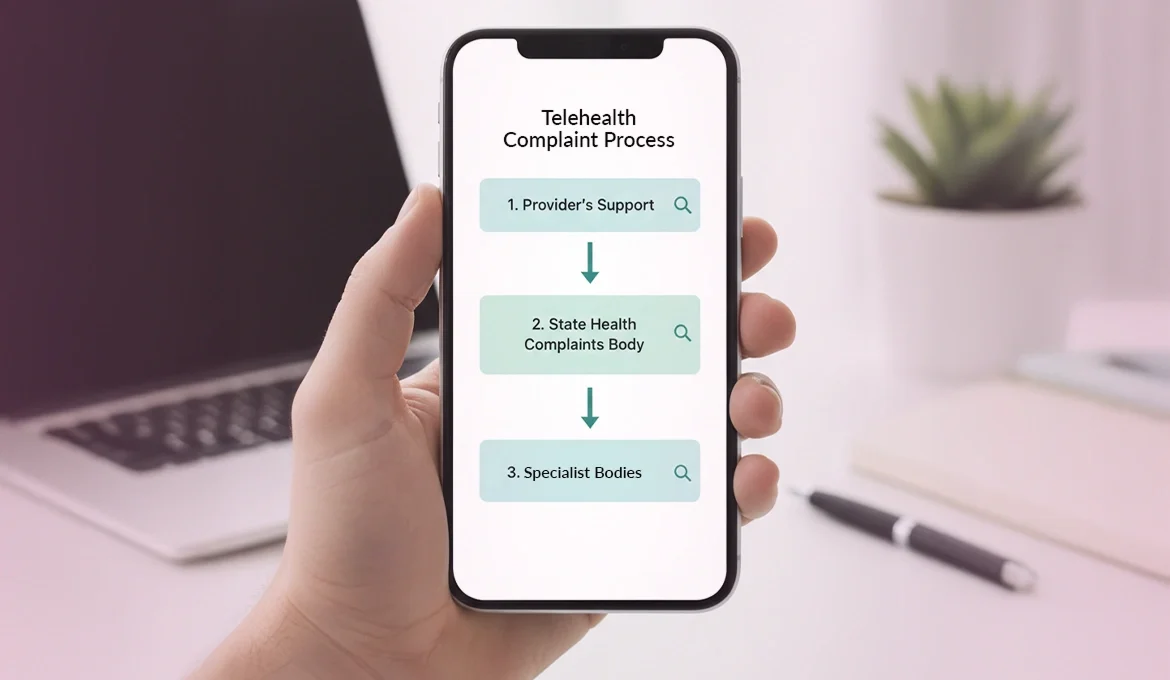
Step 1: Complain to the Provider First

The first step in resolving an issue with an on-demand telehealth provider is almost always to contact the provider directly.  Every online telehealth provider in Australia should have a clear complaints or feedback process. You can usually find this on their website under “complaints,” “feedback,” or “contact support”. Many issues can be resolved at this stage because the provider can review your consultation, listen to your concerns and offer a remedy such as a repeat consultation, clarification or correction of an error.

For matters involving communication breakdowns, unexpected fees or administrative errors, addressing the problem directly with the telehealth service is usually the fastest and simplest route.

Step 2: Escalate to Your State or Territory Health Complaints Body

If you are not satisfied with the provider’s response, your next step may be to escalate the complaint to your state or territory health complaints body. These independent agencies oversee complaints about healthcare services, including telehealth providers.

They cover concerns such as inappropriate or unsafe care, rudeness, poor communication, refusal to provide adequate assessment, incorrect advice, or problems with follow-up care.

Each state has its own commission, such as the Health Care Complaints Commission (HCCC) in New South Wales, the Office of the Health Ombudsman (OHO) in Queensland, or the Health Complaints Commissioner (HCC) in Victoria. These bodies are independent and can investigate the service, request records, speak to clinicians involved and issue recommendations or sanctions where necessary.

If the Issue Is About a Specific Doctor: AHPRA and the Medical Board

In situations where the issue relates to the behaviour, professionalism or safety of an individual doctor rather than the telehealth company itself, the appropriate body is the Australian Health Practitioner Regulation Agency (AHPRA) and the Medical Board of Australia. AHPRA handles notifications about doctors who may have behaved unprofessionally, prescribed inappropriately, acted outside accepted medical practice or provided unsafe care in any setting, including telehealth.

Many people assume AHPRA only deals with in-person clinics, but telehealth doctors must meet the same professional standards. If a doctor’s conduct during a telehealth consultation made you feel unsafe, dismissed or improperly treated, you are entitled to lodge a notification with AHPRA. AHPRA will assess the concern and determine whether a formal investigation is required.

If It’s a Privacy Concern: OAIC

Privacy issues are also increasingly common in on-demand telehealth, particularly when medical records, emails or identification details are handled electronically. If your concern relates to how a telehealth provider stored, transmitted or accessed your personal information, you can contact the Office of the Australian Information Commissioner (OAIC), which is responsible for investigating privacy breaches.

This includes situations where information was shared without consent, handled insecurely or exposed due to data mishandling. Telehealth providers are bound by the Privacy Act and the Australian Privacy Principles, meaning they must protect your confidential medical information with the same care as any hospital or GP clinic.

If It’s About Fees or Misleading Claims: ACCC

Some complaints involve payments, refunds, hidden fees or misleading advertising. In these cases, the Australian Competition and Consumer Commission (ACCC) may also be relevant. While the ACCC does not resolve individual disputes, it oversees compliance with Australian Consumer Law, which applies to telehealth providers just as it does to any other service.

Telehealth companies should be transparent about pricing, clearly state what services are included and avoid misleading claims about Medicare eligibility, prescription guarantees or clinical outcomes. If you believe you were misled, you can raise the matter with the ACCC while still pursuing a resolution through the provider or your state health complaints body.

What to Include in Your Complaint

To get a faster, clearer outcome, it helps to be specific. Include the date and time of the consultation, the provider's name and (if you have it) the clinician’s name. Briefly explain what happened, what you were expecting and what you would like as a resolution. For example, a clarification, a copy of your notes, a refund review or a second opinion. If you have screenshots, emails, invoices or chat logs, keep them handy in case you are asked for supporting information.

If you believe someone’s safety is at risk, such as a serious prescribing concern, say that clearly in your complaint and consider escalating sooner rather than later.

Final Takeaway

The key takeaway is that telehealth complaints in Australia follow the same principles as traditional healthcare complaints: start with the provider, escalate to your state health commission if needed, and involve AHPRA, OAIC or the ACCC depending on the nature of the issue. The regulation of online medical services is robust, and patients are protected by many of the same rights they have when visiting a GP clinic in person.

For patients navigating the digital health landscape, understanding how to raise concerns is essential. Telehealth is regulated and widely trusted, but no system is flawless. Knowing how to make a complaint empowers Australians to protect their health, hold providers accountable and support the continued improvement of digital care.

This article was created in collaboration with Richard Skimmin, drawing on practical experience in how telehealth services operate and how complaints are typically handled across Australia.